
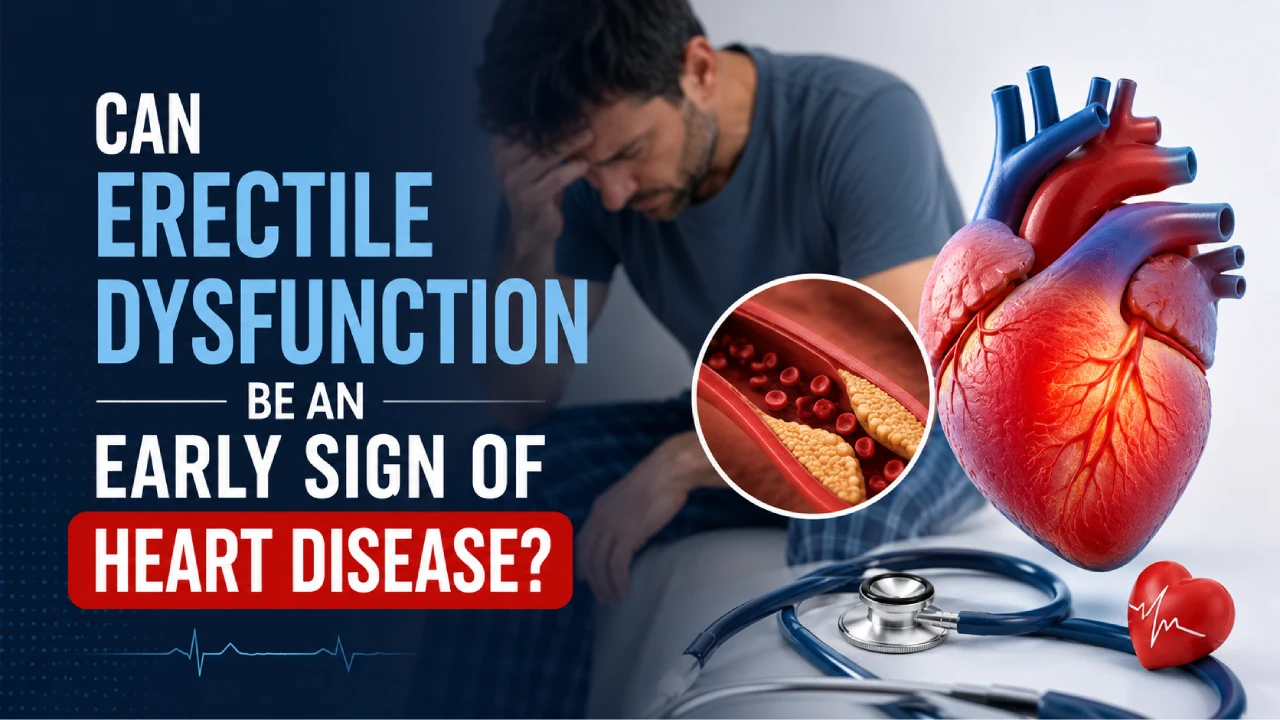
Most men who experience erectile dysfunction think about it as a sexual health problem. Very few think of it as a potential warning sign from their heart. But a growing body of clinical research suggests that ED — particularly in men under 60 — can be one of the earliest indicators of cardiovascular disease, sometimes appearing years before any chest pain or cardiac event.
This does not mean every man with ED has heart disease. But it does mean that ED deserves to be taken seriously — not just as a bedroom problem, but as a signal worth investigating. This guide explains the science behind the ED-heart disease connection, how to assess your own risk, and what to do next.
ED as a Cardiovascular Warning Signal
A landmark study published in the Journal of the American College of Cardiology found that men with ED had a 44% higher risk of cardiovascular events compared to men without ED. The risk was even higher in men under 60. Cardiologists increasingly describe ED as "angina of the penis" — a symptom of the same systemic vascular disease that causes heart attacks.
- The Biological Link Between ED and Heart Disease
- Why Blocked Arteries Cause ED First
- What the Research Says
- Shared Risk Factors: ED and Heart Disease
- Warning Signs You Should Not Ignore
- What to Do If You Have ED and Are Worried About Your Heart
- Can You Still Treat ED Safely?
- Frequently Asked Questions
- Conclusion
The Biological Link Between ED and Heart Disease
To understand why ED can signal heart disease, you need to understand what causes an erection in the first place — and why the same system that fails in ED also fails in cardiovascular disease.
An erection requires healthy, flexible blood vessels capable of dilating rapidly to increase blood flow to penile tissue. This process depends on the inner lining of blood vessels — the endothelium — functioning correctly. When the endothelium is healthy, it produces nitric oxide, which signals smooth muscle in blood vessel walls to relax and allow blood flow.
Endothelial dysfunction — damage to or impairment of this inner lining — disrupts this process. Blood vessels cannot dilate effectively, blood flow is reduced, and erections become difficult or impossible to achieve. This is the same mechanism that, in coronary arteries, leads to reduced blood flow to the heart — causing angina, and eventually heart attacks.
The Core Connection: ED and coronary artery disease share the same root cause — endothelial dysfunction and atherosclerosis (arterial narrowing). They are different expressions of the same underlying vascular disease, occurring in different parts of the body.
Why Blocked Arteries Cause ED First
If ED and heart disease share the same cause, why does ED often appear before cardiac symptoms? The answer lies in a simple piece of anatomy: artery size.
Penile Arteries: 1–2mm diameter
The arteries supplying the penis are among the smallest in the body. Even minor atherosclerotic narrowing causes a significant reduction in blood flow. This is why the penis feels the effects of vascular disease first — small arteries are the canary in the coal mine.
Coronary Arteries: 3–4mm diameter
The arteries supplying the heart are 2–3 times wider. The same degree of narrowing that dramatically reduces penile blood flow may cause only a minor reduction in coronary blood flow — producing no chest pain symptoms yet. This is why cardiac disease becomes symptomatic later.
This size differential means that ED can precede a heart attack or angina diagnosis by 3 to 5 years in many men. By the time a man develops chest pain on exertion, the atherosclerosis affecting his coronary arteries may already be advanced — and his ED will have been giving him warnings for years.
The "Penile Artery First" Principle: Cardiologists use the term "the penis as a vascular health barometer." Because penile arteries are smaller, they reflect systemic vascular health earlier and more sensitively than coronary arteries. ED in a man under 60 with no obvious psychological cause should prompt cardiovascular risk assessment.
What the Research Says
The evidence linking ED to cardiovascular disease is now substantial and consistent across multiple major studies:
Key Research Findings
A major meta-analysis published in the European Heart Journal analysed data from over 92,000 men across multiple countries and found that ED was independently associated with a 44% increase in risk of major cardiovascular events — even after adjusting for other cardiovascular risk factors such as age, blood pressure, diabetes, and smoking.
A Princeton Consensus Panel — a group of leading cardiologists and urologists — concluded that ED in men under 70 without obvious psychological cause should be treated as a cardiovascular risk marker and trigger a full cardiovascular risk assessment. Their guidance, widely adopted in cardiology practice, states: "All men with ED and no cardiac symptoms should be evaluated for cardiovascular disease before ED treatment is initiated."
Research from the Massachusetts Male Aging Study confirmed that men with complete ED at age 40 were significantly more likely to experience cardiovascular events over the following 25 years than men without ED — even when other risk factors were controlled for.
Shared Risk Factors: ED and Heart Disease
One of the clearest pieces of evidence for the ED-heart disease connection is the degree to which both conditions share the same risk factors. These are not coincidental overlaps — they reflect the same underlying vascular damage operating through the same biological pathways.
High Blood Pressure
Hypertension damages arterial walls and accelerates atherosclerosis — reducing blood flow to both the penis and heart simultaneously.
Diabetes
Diabetic vascular damage is one of the strongest predictors of both ED and cardiovascular disease. Men with diabetes are 3x more likely to develop ED than non-diabetics.
Smoking
Tobacco accelerates endothelial dysfunction and arterial stiffness. Smokers have significantly higher rates of both ED and coronary artery disease.
High Cholesterol
LDL cholesterol deposits in arterial walls form the plaques that narrow and stiffen arteries — reducing blood flow to penile and cardiac tissue alike.
Obesity
Excess body fat — particularly abdominal — suppresses testosterone, promotes inflammation, and directly impairs blood vessel function. Strongly associated with both conditions.
Physical Inactivity
Sedentary lifestyle reduces cardiovascular efficiency and endothelial health. Regular exercise is one of the most powerful interventions for both ED and heart disease.
Warning Signs You Should Not Ignore
Not all ED is cardiovascular in origin — psychological causes, medication side effects, and hormonal factors all play a role. But certain patterns of ED are more strongly associated with underlying vascular disease and should prompt a GP consultation regardless of age.
ED Patterns That Warrant Investigation
- ED developed suddenly with no obvious psychological trigger
- You are under 60 and experiencing consistent ED
- ED accompanied by reduced exercise tolerance
- You have any cardiovascular risk factors (BP, diabetes, smoking)
- ED is worsening progressively over months
- You experience chest tightness during or after sex
- Family history of early heart disease (under 55 in men)
- ED alongside leg pain during walking (peripheral artery disease)
ED Patterns with Lower Cardiac Risk
- ED that is situational — only with certain partners
- Normal morning erections present
- ED developed after starting a new medication
- Linked to high-stress or anxiety periods
- No cardiovascular risk factors present
- Younger men with clear psychological triggers
- ED resolves when stress is addressed
- ED that responds fully to PDE5 inhibitors
The Presence of Morning Erections: Spontaneous nocturnal or morning erections are a strong indicator that the physical mechanisms for erection are intact. Their consistent absence — particularly in men who previously had them — points more strongly toward a vascular or hormonal cause rather than a purely psychological one, and warrants investigation.
What to Do If You Have ED and Are Worried About Your Heart
ED should not be dismissed as an embarrassing inconvenience. If you are experiencing consistent ED — particularly if you are under 60 or have any cardiovascular risk factors — taking these steps is important for your long-term health.
See Your GP — Do Not Delay
A GP can assess your cardiovascular risk profile, check your blood pressure, cholesterol, and blood sugar, and refer you for further testing if needed. Erectile dysfunction raised in a GP context should prompt a cardiovascular risk assessment — do not allow embarrassment to prevent this conversation. It could be one of the most important health consultations of your life.
Know Your Numbers
Blood pressure, total and LDL cholesterol, fasting blood glucose, and BMI are the key cardiovascular markers every man with ED should know. You can check blood pressure at most pharmacies for free. Ask your GP for a full cardiovascular risk screen — this is readily available on the NHS for men over 40.
Address Modifiable Risk Factors
Quitting smoking, losing excess weight, reducing alcohol, improving diet, and starting regular cardiovascular exercise all simultaneously reduce cardiovascular risk and improve erectile function. These are not separate agendas — the same lifestyle changes that protect your heart also restore erections, often without medication.
Review Your Current Medications
Several commonly prescribed medications — including some beta-blockers, thiazide diuretics, and antidepressants — have ED as a recognised side effect. If your ED developed after starting a new medication, discuss alternatives with your GP before assuming a vascular cause. Do not stop any prescribed medication without medical guidance.
Treat the ED — It Matters for Your Confidence and Relationship
Investigating the cardiovascular link does not mean ignoring the ED itself. Effective treatment is available, and using it safely while you address the underlying risk factors is entirely appropriate. Improved sexual confidence also reduces anxiety-driven ED — creating a positive cycle rather than a negative one.
Can You Still Treat ED Safely If You Have Heart Disease?
For many men with cardiovascular risk factors or established heart disease, ED medications are safe — but with important conditions that must be respected.
| Cardiovascular Situation | ED Medication Safety | Key Consideration |
|---|---|---|
| High blood pressure (controlled) | ✅ Generally safe | Start at lowest dose. Monitor blood pressure on first use. |
| High blood pressure (uncontrolled) | ⚠️ Caution — seek GP advice | Treat the hypertension first before starting ED medication. |
| High cholesterol | ✅ Generally safe | No direct interaction with statins. Take as normal. |
| Diabetes (type 1 or 2) | ✅ Generally safe | ED medication may be less effective due to vascular damage. Higher doses may be needed. |
| Stable angina (not on nitrates) | ✅ Generally safe | Confirm with cardiologist. Do not use if nitrates prescribed. |
| On nitrate medications (GTN spray etc.) | 🚫 Absolute contraindication | Never combine PDE5 inhibitors with nitrates. Potentially fatal blood pressure drop. |
| Recent heart attack or stroke (under 6 months) | 🚫 Avoid until cleared by cardiologist | Sexual activity itself requires cardiac clearance. ED medication secondary to this. |
| Heart failure (severe) | ⚠️ Seek specialist advice | Low-dose tadalafil has shown cardiovascular benefit in some studies, but specialist input required. |
The Nitrate Rule Is Absolute: If you take any nitrate medication — GTN spray, isosorbide mononitrate, isosorbide dinitrate, or recreational nitrites (poppers) — you must never take sildenafil, tadalafil, or any PDE5 inhibitor. The combined blood pressure drop can be severe and potentially fatal. There are no exceptions to this rule.
Treat Your ED Safely — Genuine UK Options
Cenforce 50mg is the recommended starting dose for men with cardiovascular risk factors. Discreet UK delivery, genuine products.
Frequently Asked Questions
Conclusion: ED Is More Than a Bedroom Problem
The evidence is clear and increasingly accepted in mainstream cardiology: erectile dysfunction — particularly in men under 60 — can be one of the earliest warning signs of cardiovascular disease. It shares the same biological root cause, the same risk factors, and in many men precedes cardiac symptoms by several years.
This does not mean every man with ED needs to panic about his heart. But it does mean that ED deserves to be taken seriously — investigated rather than simply medicated over. A GP visit that assesses your cardiovascular risk profile is not an overreaction. It is sensible, proactive healthcare.
The good news is that the lifestyle changes that protect your heart — exercise, diet, weight loss, quitting smoking — also directly restore erectile function. You are not fighting two separate battles. You are fighting one, and winning it improves both your sexual health and your longevity simultaneously.
In the meantime, effective ED treatment is available and safe for the majority of men — even those with cardiovascular risk factors — when used at the correct dose with appropriate precautions.
Safe ED treatment starts here: Cenforce 50mg → | Vidalista (Tadalafil) → | Full Shop →
Related Articles
Erectile Dysfunction Symptoms: The Complete UK Guide
Over 60sBest ED Pill for Men Over 60: A Complete UK Guide
DosageCenforce 50mg vs 100mg: Which Dose Is Right for You?
| Written By |
Olivia Bennett (Content Writer)
6+ years of experience in men’s health and pharmaceutical content. |
|---|---|
| Medically Reviewed By |
Dr. Nick Linton 12+ years of clinical experience in men’s health and sexual medicine. |
| Last Reviewed | 27/07/2026 |
| Next Review | October 25, 2026 |
| Category | Men's Health |
Written and reviewed by

Olivia Bennett
Health Content Writer & Medical Research Contributor